jan-one, two thousand and twenty six: the vondelkerk burns down
The Vondelkerk in Amsterdam was badly damaged during a fire on NYE. What should the future of the building be?
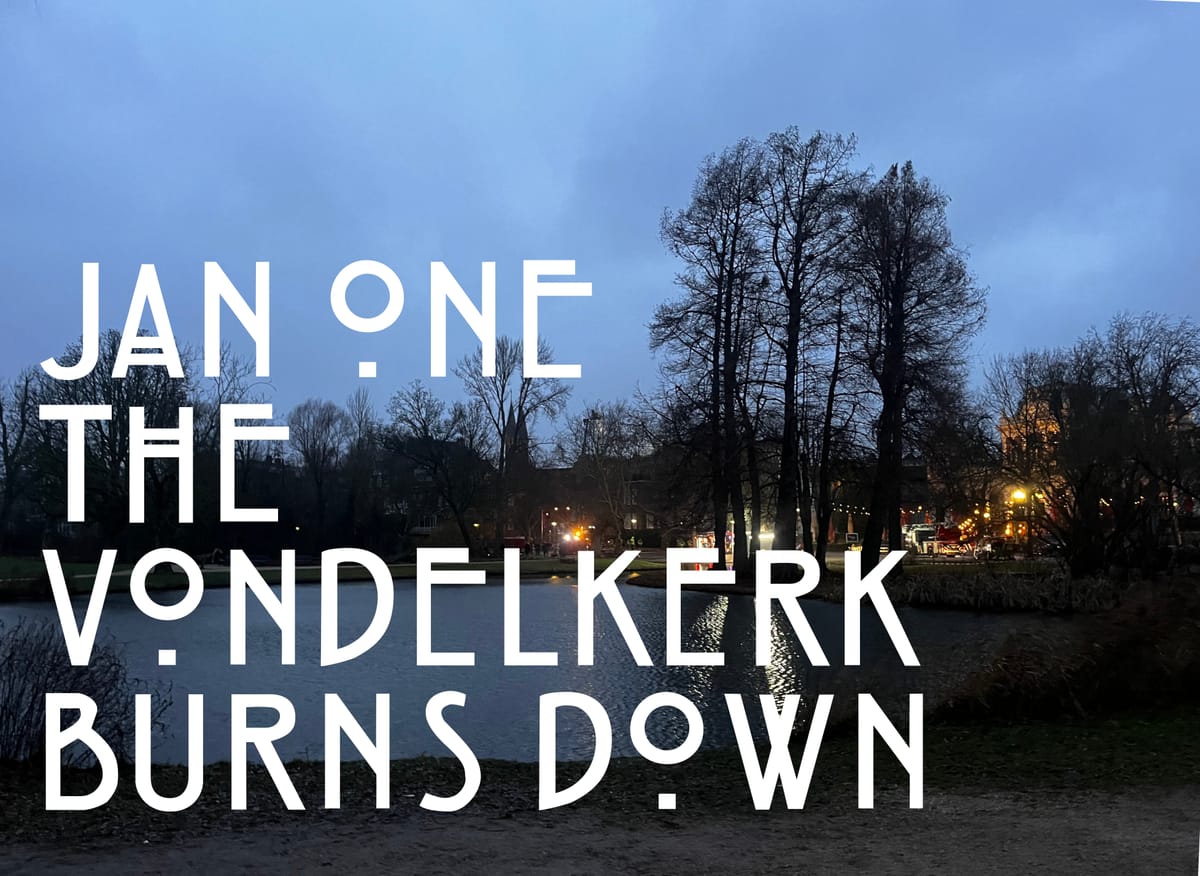
Just after the beginning of the new year, a fire started in the Vondelkerk. The cause is not known yet, but considering it was New Year's Eve, the culprit seems obvious. People play around with fireworks, and poof, suddenly the fire is more than just sparks. I'm always surprised at how long it takes for a fire to be put out; the fire was first reported around one in the morning, and it was 'under control' ten hours later. I went to look at the scene in the morning, on my way back home from my own NYE celebrations, but I couldn't see the fire. Today I went there again, and I circled around the building to see what's destroyed & what's standing. There was an alarm going off inside, but inside had become outside. The alarm can't go on forever; someone will turn it off, and the Vondelkerk will enter the next phase of its existence.
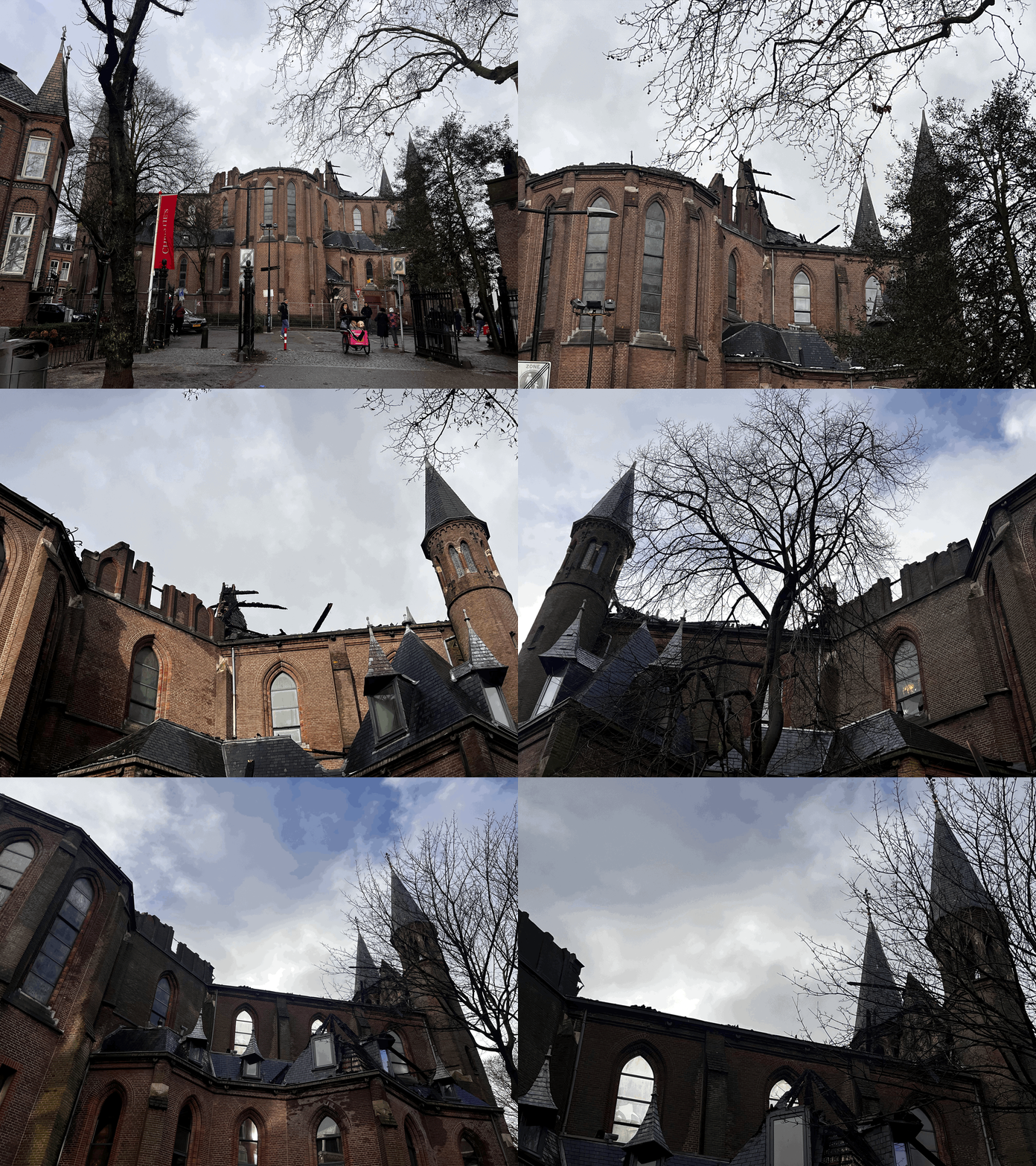
I love fires, as a spectator.
I first became fascinated by the burning down of buildings when the art school I used to go to burned down for the second time, just a few months before the restorations from the first fire would be completed. People would joke that some disgruntled art student had started the fire, and I might have fit that description, but I wasn't in the country at that time. I remember waking up in the morning and seeing news: historic Glasgow School of Art building on fire, again. I cried, it was unimaginable, what were the chances?
I have only seen the building, before it was ravaged by the fires, in pictures which do not seem to capture its grandeur. I know what it looks like from the outside, I believe it had a beautiful library, but I don't know how it felt to walk inside, how it sounded, the smell. The architect of the building, Charles Rennie Mackintosh, haunts the art school and the city. He is the art school's most cherished alumnus, the face of the Glaswegian Art Nouveau. His iconic typeface, his elegant and flourishing style, the muted pastels of his creations. The Mackintosh was one of the few buildings of his that survived into the twenty-first century. So, when it burned down, it seemed obvious what had to be done: this building had to be restored.
The first fire, in 2014, was a tragic accident; someone's graduate project caught fire, and took everyone's work with it, including the building. It gave the Mackintosh a mythical quality. It was this building from before, and everything at the art school would be out of balance until the Mackintosh was restored to its glory. In general, there wasn't enough space for all of the students; my department was in a former children's hospital with a haunted elevator. The same year of the first fire, the "new" building of the art school opened, and it won a prize for worst design. The Mackintosh was our saviour, a symbol of what the art school could be. But I don't believe everything was all gloom and doom; the restoration of the building required extensive research, technical experimentation, and love for design. The people working on the building cared deeply for it, and through their knowledge and experience, the building could be restored not just to its pre-fire state, which was apparently leaky and a little decrepit, but it could be reborn.
One of the things that saddened me the most after the second fire, in 2018, was that all of those hours of restoration work, recreating the little design flourishes that made the building so unique, would be lost. Thankfully, this wasn't the case, as not everything had been installed yet. Unfortunately, the second fire caused more structural damage to the building, and there was a danger that the building could collapse. It's not known how the second fire started, but it probably wasn't an unhappy art school (ex-)student.
After the first fire, it seemed evident & reasonable to restore the building, but this time it wasn't so obvious. Not that I had any say in it, but I questioned a second restoration too: maybe the Mackintosh's time was simply over? Would it still be the 'same building', or would it be a Ship of Theseus, all of its parts replaced? The original building was built at the turn of the nineteenth to twentieth century, a different era. Would it still make sense to build it now, or would it just turn the building into a zombie, a creation out of time? What message do you send to art school students when, rather than creating something new, you steadfastly hold onto the past?
Woo, another fire!
Luckily for my pondering, sadly for the people of Paris, a year after the Mackintosh fire, the Notre-Dame burned down. In daylight, everyone could see the destruction. It caused a lot more buzz, probably because most people know where Paris is & many people have seen Disney's the Hunchback of Notre Dame. I think I went there once as a child, but I couldn't appreciate the beauty of churches back then. The Notre-Dame is an interesting building with a rich history, although I think it's a little overhyped. A large part of the legacy of Notre-Dame derives from Victor Hugo, the author of 'The Hunchback of Notre-Dame.' From my memory: in his time, the church had fallen into disrepair because people stopped caring about it. He wrote this book, people started caring, and money went into restoring the building. The project was led by Viollet-le-Duc; he made up some historical research and created a fantasy-Gothic style. They added some towers, new decorations, and so the Notre-Dame before the fire was mostly a nineteenth-century vision of how a Gothic church might have looked. The 'church' is from the twelfth century, but the 'building' not so much.
So, when the Notre-Dame burned down, I was quite interested to see what they would do: I believe it would have been in the spirit of the history of the building to create a twenty-first-century interpretation of a Gothic building. Dare to create something new, marry the past with the present. I saw some really cool proposals but alas, the French government chose the boring & safe option. Perhaps in some ways this is a reflection of how our technology has advanced: there was so much information available on the Notre-Dame in the form of 3D scans and drawings. The technological prowess here is to demonstrate how well that information can be replicated: from physical, to digital, to physical again. However, I think part of the value that a historical building has is its physical endurance, the fact that these materials in this structure have survived until today. You can imitate the form, but you cannot imitate its history. Although the restoration was done immaculately, it feels soulless to me. A vanity project that doesn't honour the past but tries to mimic it without any creativity. It reflects a fear of change, a desire to hold onto a world that has passed. The church has such a rich history, and it has seen many different shapes, so why can't we play with it? Why do we want to freeze time?
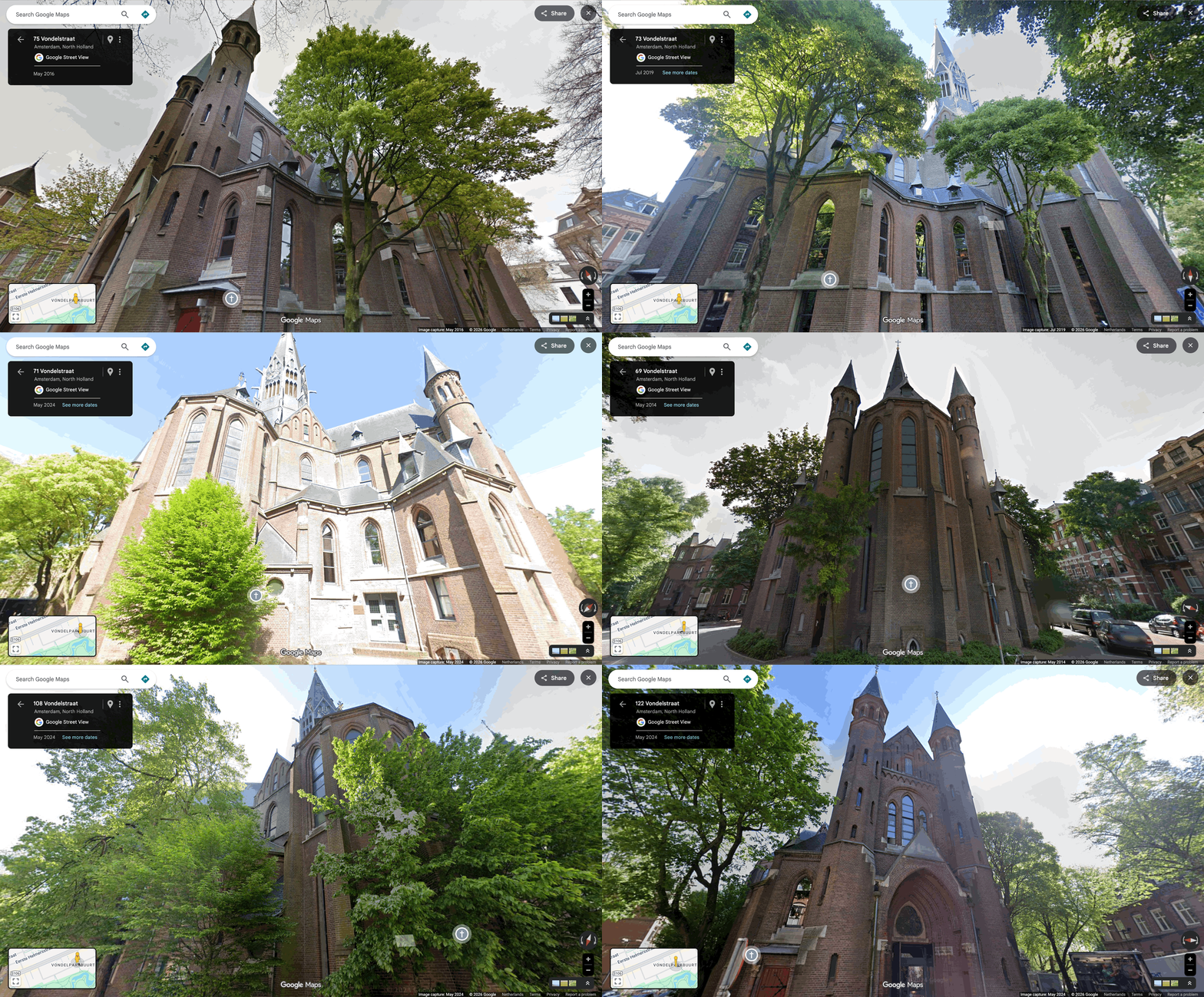
Back to the present
Now, it's time to get back to the Vondelkerk. I remember walking around it this summer, waiting for a friend. Since it burned down, I've learned more about it than I would have if it hadn't. The architect: Pierre Cuypers, who also designed the Rijksmuseum & Centraal Station Amsterdam. It was originally built in 1888; there had also been a fire in 1904, when Cuypers was still alive & he fought to restore it. It hadn't been a Catholic church since the seventies, and it was a 'multi-functional' building before the fire broke out. There were church services on Sundays, it was a wedding location, and a concert venue. The neighbourhood was proud of the church, and although it had lost its original function, its beauty brought people joy.
So, what should happen to the Vondelkerk? I'm not sure. People are collecting money to restore the building. However, does it make sense to restore the building as a church, considering that it would actually serve very few people in the local community? Will the fire awaken new spirits? Some of the beauty of fire is its potential for renewal. The sudden destruction brings to light what the value of the building was, and what it could have been. The fire adds to the myth, to the story. It creates an opportunity to think about new directions, what we need and how we use the space. The destruction of the church is outside of our control: it's a great loss as well as a liberation. It's an opportunity to rethink what our community spaces could be. In a world where many people are choosing to escape religion, yet are longing for connection, this might be a chance to imagine a new space for people to come together. It was a beautiful building at a wonderful location, and I hope we can imagine something worthy for its future.